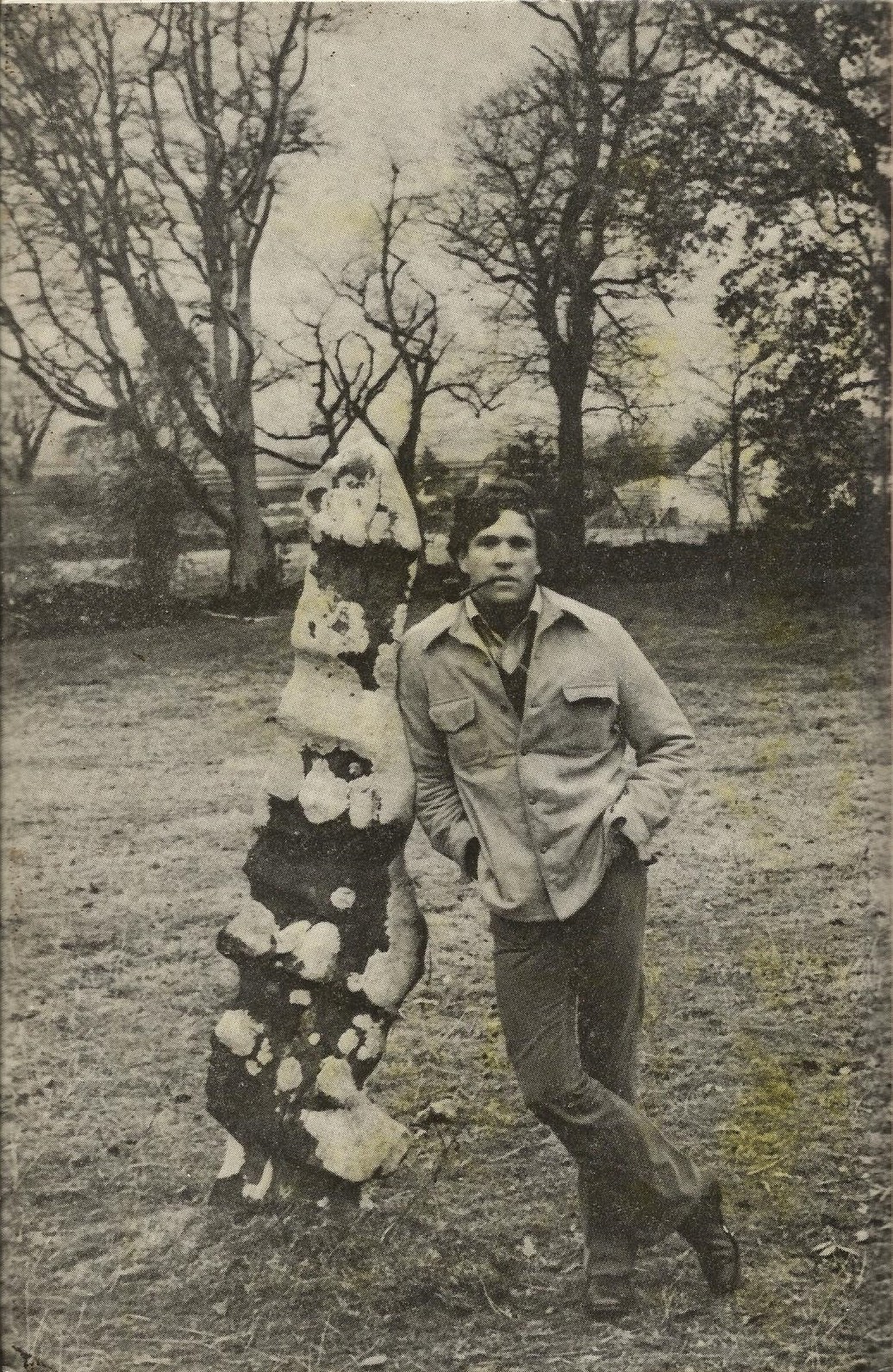
Title: The Desperadoes and Other Stories
Author: Stan Barstow
Year of publication: 1961, Penguin edition 1965
Back cover blurb: 'A group of young tearaways on a night out that begins with horse-play and ends in tragedy; the loneliness of a drunken miner's wife; a war-shocked ex-sailor forced beyond endurance - these are some of the stories included in this collection.'
Reading reveals: Stan Barstow wrote A Kind of Loving, the great Kitchen Sink novel that isn't Room at the Top or the other one. In this collection of stories, generally impoverished people do quite banal things, like appear in amateur dramatics or redecorate a flat. They don't express themselves in particularly interesting ways, and not a lot really happens for much of it. Barstow's trick, however, which he pulls off with aplomb in pretty much every story, is to end on a devastating detail that exposes the innermost desires and fears of his characters. Very much the work of someone who knows what they're doing.
Random paragraph: 'She did not hold his look but sipped tea from her cup, looking past him through the lace-curtained window into the narrow street. He wished once again for the power to read her mind.'
Purchase
Sunday, 21 January 2018
Monday, 12 June 2017
A Fine Madness
Title: A Fine MadnessAuthor: Elliott Baker
Year of publication: 1964, Penguin edition 1966.
Back cover blurb: 'He is a poet, and the world is not shaped for poets. His ex-wife's father is after him for long overdue alimony and his violent relationship with the woman he now lives with threatens to destroy them both. So when the psychiatrists start to 'help' him, they had better watch out for their own minds - and their wives! Because this poet will always flee from sanity.'
Reading reveals: Samson Shillitoe is the worst kind of Twentieth Century creative male - a hard drinking woman-beater who will sleep with just about anyone as long as it destroys lives. A series of unfortunate incidents leads to him coming under psychiatric care, with hilarious lobotomy-involving consequences.
Actually a finely-constructed farce, only let down by a few too many minor characters getting the limelight and the odd needlessly confusing scene (a group of psychiatrists get the results of a vote while in the middle of voting on something else, for instance). Maybe not quite as funny as it needs to be. It's no Confederacy of Dunces, but it's next rung down.
Cover shows Sean Connery up a pole from the film version. Disappointingly, he does not spend the whole film up the pole, as I had at first assumed.
Random paragraph: '"But I did dream it last night." Shillitoe sat up and stretched. "I often dream of things I've read. One night last year, I dreamt most of War and Peace. Naturally I overslept."'
Purchase
Friday, 12 May 2017
Night Games
Title: Night Games
Author: Mai Zetterling
Year of publication: 1966, Panther Edition 1968
Back cover blurb: 'we live in the mind of a teenage boy - the macabre, grotesque nightmare of his memories: sexual obsession with his promiscuous mother; the ageing aunt who shares his strange cannibalistic games; the great luxurious house that envelopes them like a womb - or a morgue... And in the present there's the beautiful Mariana, his one hope of rebirth. But first he must exorcise his past, so they enter the human hell of the night games - humiliating, degraded, profane...
MAI ZETTERLING, the Swedish actress and film director, astonished the world with her first outrageous novel, and then turned it into an outrageous film - hailed, damned and the first to be censored at the Venice Film Festival.'
I met Mai Zetterling once, when I was fourteen. It was at the premiere of the film version of Roald Dahl's The Witches, directed by Nicolas Roeg, which was held at the prestigious location of the newly-opened Cannon multiplex at Ocean Village, Southampton. Zetterling, who during the fifties and early sixties was a stalwart of British film, adding a touch of Swedish sophistication to many a potboiler, played the grandmother in it, and I had come second in a short film competition with my existential super-eight meisterwerk, The True Face. That there were only two entries in total is neither here nor there. Anyway, after receiving my plaque, Zetterling introduced herself and explained that she was an actor and filmmaker and suggested that perhaps one day I would follow in her footsteps and become a professional filmmaker also. This, of course, did not happen. Well, you know, with one thing and another... I'm sorry, Mai. It's just not the way my life panned out. Please forgive me, Mai. Why can't you forgive me? Get out of my head, Mai. GET OUT OF MY
Zetterling did not mention that she had also written a novel, which she had then adapted into her first feature film as director. I did, nevertheless, go on to write a couple of novels myself. Is that enough for you, Mai? Is that enough? WHY ISN'T THAT ENOU
The novel, like the film, is a bit much. While the film version is like watching Fellini, Bunuel and Bergman put through a mangle (John Waters is a fan), the novel is similarly excessive, with every detail thoroughly mined for psychodramatic effect as we examine a man's fucked-up childhood memories of his sexy mother, which overall is quite exhausting. Nevertheless, that someone so established in one field would throw caution to the wind and do something quite this barmy in another is to be celebrated. It is the type of novel Martine McCutcheon one day needs to write.
Random paragraph: 'Our cover is, I suppose, not unoriginal, though at first I don't approve of it. Our atrocious efforts are bound in pubic hair. Myself rather taken by textures, I will reluctantly admit that it is a pleasant thing to handle - though in the end becoming rather goatlike and cheesy in a locked drawer. But Albin says it is such an agreeable pastime to hunt for it that I haven't the heart to deny him this one small pleasure.
Purchase
Author: Mai Zetterling
Year of publication: 1966, Panther Edition 1968
Back cover blurb: 'we live in the mind of a teenage boy - the macabre, grotesque nightmare of his memories: sexual obsession with his promiscuous mother; the ageing aunt who shares his strange cannibalistic games; the great luxurious house that envelopes them like a womb - or a morgue... And in the present there's the beautiful Mariana, his one hope of rebirth. But first he must exorcise his past, so they enter the human hell of the night games - humiliating, degraded, profane...
MAI ZETTERLING, the Swedish actress and film director, astonished the world with her first outrageous novel, and then turned it into an outrageous film - hailed, damned and the first to be censored at the Venice Film Festival.'
I met Mai Zetterling once, when I was fourteen. It was at the premiere of the film version of Roald Dahl's The Witches, directed by Nicolas Roeg, which was held at the prestigious location of the newly-opened Cannon multiplex at Ocean Village, Southampton. Zetterling, who during the fifties and early sixties was a stalwart of British film, adding a touch of Swedish sophistication to many a potboiler, played the grandmother in it, and I had come second in a short film competition with my existential super-eight meisterwerk, The True Face. That there were only two entries in total is neither here nor there. Anyway, after receiving my plaque, Zetterling introduced herself and explained that she was an actor and filmmaker and suggested that perhaps one day I would follow in her footsteps and become a professional filmmaker also. This, of course, did not happen. Well, you know, with one thing and another... I'm sorry, Mai. It's just not the way my life panned out. Please forgive me, Mai. Why can't you forgive me? Get out of my head, Mai. GET OUT OF MY
Zetterling did not mention that she had also written a novel, which she had then adapted into her first feature film as director. I did, nevertheless, go on to write a couple of novels myself. Is that enough for you, Mai? Is that enough? WHY ISN'T THAT ENOU
The novel, like the film, is a bit much. While the film version is like watching Fellini, Bunuel and Bergman put through a mangle (John Waters is a fan), the novel is similarly excessive, with every detail thoroughly mined for psychodramatic effect as we examine a man's fucked-up childhood memories of his sexy mother, which overall is quite exhausting. Nevertheless, that someone so established in one field would throw caution to the wind and do something quite this barmy in another is to be celebrated. It is the type of novel Martine McCutcheon one day needs to write.
Random paragraph: 'Our cover is, I suppose, not unoriginal, though at first I don't approve of it. Our atrocious efforts are bound in pubic hair. Myself rather taken by textures, I will reluctantly admit that it is a pleasant thing to handle - though in the end becoming rather goatlike and cheesy in a locked drawer. But Albin says it is such an agreeable pastime to hunt for it that I haven't the heart to deny him this one small pleasure.
Purchase
Monday, 18 April 2016
The Dark Philosophers
Title: The Dark Philosophers
Author: Gwyn Thomas
Year of publication: 1946, Library of Wales edition 2005
Back cover blurb: 'Sex, murder and devastating black humour mark these three novellas from the 1940s. In Oscar, the narrator of death and exploitation fails to fend off the evil that envelopes him. In Simeon, the abuse of sexual and family power ends with violent death, and in The Dark Philosophers itself, the grimly humorous philosophers gather in an Italian café in the Terraces to tell the dark tale of revenge that they engineer.'
Status: Completed
Reading reveals: Welsh author Gwyn Thomas was once well known, speaking on BBC radio with some regularity. A high media profile did not guarantee posterity, however (take note, Will Self), and not even a TV drama of his life starring Anthony Hopkins could save him from a slide into near-obscurity.
I've always imagined the Welsh valleys to generally be places of God-bothering tedium, so the version presented here is quite a surprise. For a start, everyone is quite horny. Also, everyone is forced into hard compromises just to stop themselves from sinking under at a time of high unemployment and poverty. Often, these two things intersect.
The first story, Oscar, is about a man who owns a mountain and the man who looks after the man who owns the mountain. It's a disturbing tale of precisely what money will buy you when you've got some and no one else around has. It's a gruesome portrayal of a man's bestial state, and worth checking out.
The Dark Philosophers itself, despite being the work that defined Thomas, is possibly the one here that has aged the least well. The philosophers themselves, three only-occasionally employed clientele of an Italian coffee shop, have a wit so cynical it wears you down after a while, and their half-love of their own poverty is one step away from Python's Four Yorkshiremen. Some scenes seem to exist only to present them with easy targets, and their willingness to step over anybody in order to make a political point betrays them as being as monstrous in their own way as the capitalism they rail against.
Up a hill again for the final story, Simeon, where a farmer turns to incest with his daughters in their remote cottage. It's quite creepy, like a children's story that goes very wrong, and also well worth your while.
Random paragraph: '"In any case," I muttered, "I don't give a damn. Mountains, tips, Oscar, Danny, Hannah, work and pain, living and dying, it all looks terribly odd to me."'
Purchase
Author: Gwyn Thomas
Year of publication: 1946, Library of Wales edition 2005
Back cover blurb: 'Sex, murder and devastating black humour mark these three novellas from the 1940s. In Oscar, the narrator of death and exploitation fails to fend off the evil that envelopes him. In Simeon, the abuse of sexual and family power ends with violent death, and in The Dark Philosophers itself, the grimly humorous philosophers gather in an Italian café in the Terraces to tell the dark tale of revenge that they engineer.'
Status: Completed
Reading reveals: Welsh author Gwyn Thomas was once well known, speaking on BBC radio with some regularity. A high media profile did not guarantee posterity, however (take note, Will Self), and not even a TV drama of his life starring Anthony Hopkins could save him from a slide into near-obscurity.
I've always imagined the Welsh valleys to generally be places of God-bothering tedium, so the version presented here is quite a surprise. For a start, everyone is quite horny. Also, everyone is forced into hard compromises just to stop themselves from sinking under at a time of high unemployment and poverty. Often, these two things intersect.
The first story, Oscar, is about a man who owns a mountain and the man who looks after the man who owns the mountain. It's a disturbing tale of precisely what money will buy you when you've got some and no one else around has. It's a gruesome portrayal of a man's bestial state, and worth checking out.
The Dark Philosophers itself, despite being the work that defined Thomas, is possibly the one here that has aged the least well. The philosophers themselves, three only-occasionally employed clientele of an Italian coffee shop, have a wit so cynical it wears you down after a while, and their half-love of their own poverty is one step away from Python's Four Yorkshiremen. Some scenes seem to exist only to present them with easy targets, and their willingness to step over anybody in order to make a political point betrays them as being as monstrous in their own way as the capitalism they rail against.
Up a hill again for the final story, Simeon, where a farmer turns to incest with his daughters in their remote cottage. It's quite creepy, like a children's story that goes very wrong, and also well worth your while.
Random paragraph: '"In any case," I muttered, "I don't give a damn. Mountains, tips, Oscar, Danny, Hannah, work and pain, living and dying, it all looks terribly odd to me."'
Purchase
Thursday, 28 January 2016
Live Now, Pay Later
Title: Live Now, Pay Later
Author: Jack Trevor Story
Year of publication: 1963
Back cover blurb: 'Live Now, Pay Later is not quite of this world, and certainly not of the next: it belongs to the world of the 'never-never,' somewhere on the outer fringe of that provincial England which Kingsley Amis and John Braine have shown us with almost shocking frankness.
In Jack Trevor Story's provincial town - fast in the grip of Hire Purchase but living it up with brittle gallantry - we are shot into a convulsive existence of rapid results, devious politics, easy women, and easy payments. Somehow, though reluctantly, you have to hand it to the feckless Albert, prince of tally-boys, whatever squeezes he puts on the housewives. As they surrender to his promiscuous glamour, they seem to be caught up in a sorry serial where there's always another thrilling instalment next week. All except for Treasure: after eighteen months she had had enough.
You're bound to laugh at the clipped and bawdy dialogue of this social merry-go-round. But you'll wince at the cutting edge of this brilliant writing.'
Status: Completed
Reading reveals: Jack Trevor Story is best known for writing the novel The Trouble With Harry, made into a film by Alfred Hitchcock, and for being the inspiration for Jim Henson's '80s TV series The Storytrevor. Here, he explores the social menace of Hire Purchase, infecting the working classes with the promise of living beyond their means.
It begins tremendously well, with the salesman and debt collector protagonist sleazing and furtively shagging his way around town as one did before the sixties properly happened. As it goes on, however, Story spreads his net too widely, and our attention is directed towards the business meetings of estate agents and the like, and the opportunity for an immersive character study is lost. Towards the end, the kitchen sink grimness of abortion, rape and the like sits uneasily with an increasingly comic plot, and a ridiculously unlikely accidental death pretty much threw me out of the book completely. You're left with the impression of a quite old-fashioned English comic novel being awkwardly dressed in new-fangled kitchen sink clothes, which is a shame, because the early chapters pack a powerful punch. The film version does very well on IMDB though, so maybe that irons it all out a bit.
Random paragraph: 'From this Mr Callendar had reasoned there was more to Arnold than appeared on the surface; men who picked their nose in public were often underprivileged in some ghastly, unwholesome way. Later his faith was justified when he had learned that Arnold had once worked for a shady second-hand car dealer who had been handling stolen cars when the police caught up with him; it was to Arnold's immense credit, in Mr Callendar's opinion, that the car dealer and all his staff had gone to prison with the single exception of Arnold, against whom, apparently, there had been no evidence. Or at least, no believable evidence in the face of Arnold's steadfast denials.
Purchase
Author: Jack Trevor Story
Year of publication: 1963
Back cover blurb: 'Live Now, Pay Later is not quite of this world, and certainly not of the next: it belongs to the world of the 'never-never,' somewhere on the outer fringe of that provincial England which Kingsley Amis and John Braine have shown us with almost shocking frankness.
In Jack Trevor Story's provincial town - fast in the grip of Hire Purchase but living it up with brittle gallantry - we are shot into a convulsive existence of rapid results, devious politics, easy women, and easy payments. Somehow, though reluctantly, you have to hand it to the feckless Albert, prince of tally-boys, whatever squeezes he puts on the housewives. As they surrender to his promiscuous glamour, they seem to be caught up in a sorry serial where there's always another thrilling instalment next week. All except for Treasure: after eighteen months she had had enough.
You're bound to laugh at the clipped and bawdy dialogue of this social merry-go-round. But you'll wince at the cutting edge of this brilliant writing.'
Status: Completed
Reading reveals: Jack Trevor Story is best known for writing the novel The Trouble With Harry, made into a film by Alfred Hitchcock, and for being the inspiration for Jim Henson's '80s TV series The Storytrevor. Here, he explores the social menace of Hire Purchase, infecting the working classes with the promise of living beyond their means.
It begins tremendously well, with the salesman and debt collector protagonist sleazing and furtively shagging his way around town as one did before the sixties properly happened. As it goes on, however, Story spreads his net too widely, and our attention is directed towards the business meetings of estate agents and the like, and the opportunity for an immersive character study is lost. Towards the end, the kitchen sink grimness of abortion, rape and the like sits uneasily with an increasingly comic plot, and a ridiculously unlikely accidental death pretty much threw me out of the book completely. You're left with the impression of a quite old-fashioned English comic novel being awkwardly dressed in new-fangled kitchen sink clothes, which is a shame, because the early chapters pack a powerful punch. The film version does very well on IMDB though, so maybe that irons it all out a bit.
Random paragraph: 'From this Mr Callendar had reasoned there was more to Arnold than appeared on the surface; men who picked their nose in public were often underprivileged in some ghastly, unwholesome way. Later his faith was justified when he had learned that Arnold had once worked for a shady second-hand car dealer who had been handling stolen cars when the police caught up with him; it was to Arnold's immense credit, in Mr Callendar's opinion, that the car dealer and all his staff had gone to prison with the single exception of Arnold, against whom, apparently, there had been no evidence. Or at least, no believable evidence in the face of Arnold's steadfast denials.
Purchase
Tuesday, 15 September 2015
The Man Who Won the Pools
Title: The Man Who Won the Pools
Author: J.I.M. Stewart
Year of publication: 1961, Penguin edition 1963
Back cover blurb: ''E were a mardy one as a nipper, our Phil. Steady work and steady money - that's 'is motto,' said Phil Tombs's auntie on TV when he won almost a quarter of a million on the pools.
Nobody expects Phil to stay steady, however: they either take him for a rid, treat him like a proper nit, or try to organize his life for him. But Phil is no fool, and he makes an enterprising, amusing, and provocative hero as he learns the social nuances and the power of cash, charging from one adventure to another with proletarian gusto.
The author of A Use of Riches in this entertaining novel employs his incisive style to depict the English social maze through his hero's intrigued and piercing gaze.'
Status: Completed
Reading reveals: Young man from a working class environment so emotionally constipated it's a wonder everyone doesn't throw themselves onto the road in frustration wins the pools. He doesn't seem that excited about it, and neither do his friends. This makes the first half of the novel a bit of a trudge as he listens to various Marxist-informed opinions about how he can invest it in co-operatives and the like.
After a while, he goes to London and things get more interesting as he finds himself being duped into investing in a strip club and in the schemes of a mad inventor. Then there's some more class stuff and the book ends.
Although it provides a neat window into ideas about wealth and class in pre-Beatles Britain, Oxford don Stewart, whom, one suspects, has never lived like common people, completely fails to grasp the desire those without have to improve the material lot of themselves and their family, something which Thatcher would understand and exploit all too well some years later.
Overall, a worthwhile period piece that leaves you wondering why someone so devoid of dreams would bother playing the pools in the first place.
Random paragraph: '"All right, But what I say's true. The rich don't get much life - not really. They know what they're sitting on the lid of. It seeps up through their fat behinds and seeps into their heads as a haunting guilt and anxiety. You can see it in their gilded youth. All that stalking about in breeches and bowler hats is a sham. There's a complete failure of confidence underneath."'
Author: J.I.M. Stewart
Year of publication: 1961, Penguin edition 1963
Back cover blurb: ''E were a mardy one as a nipper, our Phil. Steady work and steady money - that's 'is motto,' said Phil Tombs's auntie on TV when he won almost a quarter of a million on the pools.
Nobody expects Phil to stay steady, however: they either take him for a rid, treat him like a proper nit, or try to organize his life for him. But Phil is no fool, and he makes an enterprising, amusing, and provocative hero as he learns the social nuances and the power of cash, charging from one adventure to another with proletarian gusto.
The author of A Use of Riches in this entertaining novel employs his incisive style to depict the English social maze through his hero's intrigued and piercing gaze.'
Status: Completed
Reading reveals: Young man from a working class environment so emotionally constipated it's a wonder everyone doesn't throw themselves onto the road in frustration wins the pools. He doesn't seem that excited about it, and neither do his friends. This makes the first half of the novel a bit of a trudge as he listens to various Marxist-informed opinions about how he can invest it in co-operatives and the like.
After a while, he goes to London and things get more interesting as he finds himself being duped into investing in a strip club and in the schemes of a mad inventor. Then there's some more class stuff and the book ends.
Although it provides a neat window into ideas about wealth and class in pre-Beatles Britain, Oxford don Stewart, whom, one suspects, has never lived like common people, completely fails to grasp the desire those without have to improve the material lot of themselves and their family, something which Thatcher would understand and exploit all too well some years later.
Overall, a worthwhile period piece that leaves you wondering why someone so devoid of dreams would bother playing the pools in the first place.
Random paragraph: '"All right, But what I say's true. The rich don't get much life - not really. They know what they're sitting on the lid of. It seeps up through their fat behinds and seeps into their heads as a haunting guilt and anxiety. You can see it in their gilded youth. All that stalking about in breeches and bowler hats is a sham. There's a complete failure of confidence underneath."'
Tuesday, 30 September 2014
Hard Luck
Title: Hard Luck
Author: James Maw
Year of publication: 1986, Grafton edition 1988
Back cover blurb: '"Hard Luck by James Maw is the extremely funny and touching, sentimental history of two boys growing up on a new town council estate called Prospect in post-war Britain; class, poverty, domestic violence, well-meaning idiocy and welfare bureaucracy are accurately flayed through the experiences of the endearing and astonishingly well sustained voice of one of their child victims... Dickensian satire and genuine affection... pure pleasure... take it on holiday and be grateful for mercies given"
NEW STATESMAN
For Tom and Richard, the Prospect estate is a territory to be explored and taken over. For their parents - doting Ellen and not-so-doting Frank - the estate is a brave new world (even if the underground pipes and valves don't work as smoothly as anticipated). Yes, times are changing; there's cuddly blue Winceyette instead of linen, and brightly coloured modern things instead of old fashioned junk. There's television, with fascinating programmes like "Criss Cross Quiz" and the "Dickie Henderson Show" (and Kennedy's assassination). But while nearly everyone is supposed to be having it good like never before, life for Tom and Richard isn't so easy. Their parents divorce and the twins go into the Crab Apple Home when Ellen ends up in hospital. Then there's the 11-plus...
Hard Luck is a brilliantly evocative novel - as colourful and unique as Oliver Twist and Huckleberry Finn.
'The kind of detail that evokes an era'
LITERARY REVIEW'
Status: Abandoned p. 102
Reading reveals: Here in my final entry before I hand over this blog to the masses, I am looking at a book from the inner borders of lostness. Hard Luck was well-reviewed when it came out in 1986, as attested above, and even won an award and shit, so why has it already slipped away from the collective book-reading memory?
On one level, it seems an injustice. The book is funny and well-observed. Detailing the experiences of growing up in a New Town in the late '50s, early '60s, it consists of a series of working class set-pieces, in which Christmas trees are stolen and pubs are waited outside of and that sort of thing, And yet, I stopped reading. I suppose the lack of a strong narrative thread wore me down. There are only so many tales of poverty line-level cheekiness you can absorb before you want something more.
Also, there's an assuredness to the book's belief in its own loveability that jars now. It's all a bit too cosy, even when detailing child neglect and domestic violence. That and the fact it makes so little use of its main characters being twins they may as well have just be one character most of the time.
For all that, the fact that someone in their late-twenties would write a book so nostalgic for the era of their own childhood, presenting it as a distant world gone forever, is quite fascinating, You couldn't imagine someone wanting to do quite the same thing now. (Although I sort of did in my second novel Flying Saucer Rock & Roll, but moving swiftly on...) It seems to be the thing to do here because of the series of fractures between the early '60s and the mid '80s (the Sexual Revolution, punk, Thatcherism) that made the recent past feel a very long time ago back then. I remember being dazzled by old episodes of Randall and Hopkirk (Deceased), and they were only fifteen years old back then. Late '90s A Touch of Frost doesn't have quite the same disconnect.
So, Hard Luck, possibly over-praised at the time, but still worth a look.
Random paragraph: 'But after a few weeks Frank tired of the scotch eggs. "Oh no, not another blinkin' scotch egg," he'd yell as he sat down at the table.'
Purchase
Author: James Maw
Year of publication: 1986, Grafton edition 1988
Back cover blurb: '"Hard Luck by James Maw is the extremely funny and touching, sentimental history of two boys growing up on a new town council estate called Prospect in post-war Britain; class, poverty, domestic violence, well-meaning idiocy and welfare bureaucracy are accurately flayed through the experiences of the endearing and astonishingly well sustained voice of one of their child victims... Dickensian satire and genuine affection... pure pleasure... take it on holiday and be grateful for mercies given"
NEW STATESMAN
For Tom and Richard, the Prospect estate is a territory to be explored and taken over. For their parents - doting Ellen and not-so-doting Frank - the estate is a brave new world (even if the underground pipes and valves don't work as smoothly as anticipated). Yes, times are changing; there's cuddly blue Winceyette instead of linen, and brightly coloured modern things instead of old fashioned junk. There's television, with fascinating programmes like "Criss Cross Quiz" and the "Dickie Henderson Show" (and Kennedy's assassination). But while nearly everyone is supposed to be having it good like never before, life for Tom and Richard isn't so easy. Their parents divorce and the twins go into the Crab Apple Home when Ellen ends up in hospital. Then there's the 11-plus...
Hard Luck is a brilliantly evocative novel - as colourful and unique as Oliver Twist and Huckleberry Finn.
'The kind of detail that evokes an era'
LITERARY REVIEW'
Status: Abandoned p. 102
Reading reveals: Here in my final entry before I hand over this blog to the masses, I am looking at a book from the inner borders of lostness. Hard Luck was well-reviewed when it came out in 1986, as attested above, and even won an award and shit, so why has it already slipped away from the collective book-reading memory?
On one level, it seems an injustice. The book is funny and well-observed. Detailing the experiences of growing up in a New Town in the late '50s, early '60s, it consists of a series of working class set-pieces, in which Christmas trees are stolen and pubs are waited outside of and that sort of thing, And yet, I stopped reading. I suppose the lack of a strong narrative thread wore me down. There are only so many tales of poverty line-level cheekiness you can absorb before you want something more.
Also, there's an assuredness to the book's belief in its own loveability that jars now. It's all a bit too cosy, even when detailing child neglect and domestic violence. That and the fact it makes so little use of its main characters being twins they may as well have just be one character most of the time.
For all that, the fact that someone in their late-twenties would write a book so nostalgic for the era of their own childhood, presenting it as a distant world gone forever, is quite fascinating, You couldn't imagine someone wanting to do quite the same thing now. (Although I sort of did in my second novel Flying Saucer Rock & Roll, but moving swiftly on...) It seems to be the thing to do here because of the series of fractures between the early '60s and the mid '80s (the Sexual Revolution, punk, Thatcherism) that made the recent past feel a very long time ago back then. I remember being dazzled by old episodes of Randall and Hopkirk (Deceased), and they were only fifteen years old back then. Late '90s A Touch of Frost doesn't have quite the same disconnect.
So, Hard Luck, possibly over-praised at the time, but still worth a look.
Random paragraph: 'But after a few weeks Frank tired of the scotch eggs. "Oh no, not another blinkin' scotch egg," he'd yell as he sat down at the table.'
Purchase
Wednesday, 17 September 2014
Jack in the Box
Title: Jack in the BoxAuthor: William Kotzwinkle
Date of publication: 1980, Abacus edition 1981
Back cover blurb: 'Can a young man from a small mining town find happiness as a human being? Can Jack Twiller, his mind warped by Masked Man, Tailspin, Tommy and Secret Agent X-9, ever abandon the comic book heroes of his youth and find true maturity? Does he even want to?
A hilarious odyssey through American comic-book culture of the 40s, Jack's story is witty, nostalgic and real. In this brilliant and original novel William Kotzwinkle confirms his reputation as one of the most exciting of the younger generation of American writers.'
Status: Completed
Reading reveals: Last entry I made an attempt to read the irredeemably awful E.T. The Book of the Green Planet. Despite the book's startling lack of merit, I was nevertheless curious as to how established author Kotzwinkle got the E.T. gig, and so read one of his earlier works. Although he is generally a fantasy/sci-fi writer, Jack in the Box is a coming-of-age tale, and weirdly enough it's very good indeed.
Each chapter moving on the narrative with a jump of months or years, the passing time unacknowledged in the text, Kotzwinkle manages to convincingly capture the various states of mind from child to adolescent, as his young protagonist Jack Twiller grows from playing cowboy games in the street on to drunken house parties as a rock 'n' roll greaser. There's one particular moment that captures the first stage in the death of childhood, where Twiller finds he can no longer play, that is one of the truest things I have read in fiction for a very long time. There's also a scout camp from Hell, and confusion about the manliness of vomiting that pre-dates Alan Partridge,
You can see why Spielberg sought him out. Both have an intense understanding of childhood and its joys and fears. Shame that the meeting of minds didn't work out better.
Random paragraph: 'They went straight to the place where Spider had been going up and down on Nancy. Crutch stared at the sandy grass. "I thought you had to do it on a flat rock."'
Purchase
Monday, 1 September 2014
E.T. The Book of the Green Planet
Title: E.T. The Book of the Green Planet
Author: William Kotzwinkle
Year of publication: 1985
Back cover blurb: 'THE WORLD'S FAVOURITE STORY CONTINUES...
E.T. the Extra-Terrestrial in his adventure on Earth captured the hearts of tens of millions, becoming a cult classic. This new story begins where the film ended, as E.T.'s ships is rising into the heavens.
In his wonderful new adventure, E.T. goes home to his beloved Green Planet, filled with strange and fascinating creatures. But he's lonely. E.T. misses Elliott and the good days on Earth... living in a closet, drinking beer, and wearing a wig.
Here is the story of how E.T. solves his problem...'
Status: Abandoned p. 34
Reading reveals: Hard to imagine now, but established author William Kotzwinkle's novelization of Steven Spielberg's E.T. The Extra-Terrestrial was the biggest-selling novel of 1982 in the US. Spielberg was so impressed by Kotzwinkle's take on the story, complete with the dubious addition of E.T. falling in love and lust with Elliott's mom, he gave him the task of puffing out his own vague ideas for a sequel into an original novel.
I actually purchased this when about nine years old. I don't think I ever finished it. I remember being overwhelmed by the task of trying to picture what was described, as E.T. returns to his home planet and encounters all sorts of strange life-forms in mind-blowing environments.
Still, the book haunted me. Would reading as an adult be a more fruitful experience, my mature mind more up to the challenge laid down by the text?
The answer is no. It is dreadful. The human characters, whose day-to-day lives E.T. clumsily interrupts with telepathic messages, bear virtually no relation to their movie counterparts, while the alien creatures E.T. hangs out with, actually giant sentient plants, are called things like Jumpums, Flopglopples and Beeperbeans and are as irritating as their names suggest.
My nine year-old self was right to give up on this. You should listen to him. But please first purchase the book via the link provided below as I get a percentage.
Random paragraph: 'The youthful creature was tending a crop of legumes called Igios Atra, or as they were more affectionately known - Beeperbeans, which gave off a sharp beeping sound when their blossoms opened. As it was springtime, there was considerable beeping going on, and the worker had corks in his ears.'
Purchase
Author: William Kotzwinkle
Year of publication: 1985
Back cover blurb: 'THE WORLD'S FAVOURITE STORY CONTINUES...
E.T. the Extra-Terrestrial in his adventure on Earth captured the hearts of tens of millions, becoming a cult classic. This new story begins where the film ended, as E.T.'s ships is rising into the heavens.
In his wonderful new adventure, E.T. goes home to his beloved Green Planet, filled with strange and fascinating creatures. But he's lonely. E.T. misses Elliott and the good days on Earth... living in a closet, drinking beer, and wearing a wig.
Here is the story of how E.T. solves his problem...'
Status: Abandoned p. 34
Reading reveals: Hard to imagine now, but established author William Kotzwinkle's novelization of Steven Spielberg's E.T. The Extra-Terrestrial was the biggest-selling novel of 1982 in the US. Spielberg was so impressed by Kotzwinkle's take on the story, complete with the dubious addition of E.T. falling in love and lust with Elliott's mom, he gave him the task of puffing out his own vague ideas for a sequel into an original novel.
I actually purchased this when about nine years old. I don't think I ever finished it. I remember being overwhelmed by the task of trying to picture what was described, as E.T. returns to his home planet and encounters all sorts of strange life-forms in mind-blowing environments.
Still, the book haunted me. Would reading as an adult be a more fruitful experience, my mature mind more up to the challenge laid down by the text?
The answer is no. It is dreadful. The human characters, whose day-to-day lives E.T. clumsily interrupts with telepathic messages, bear virtually no relation to their movie counterparts, while the alien creatures E.T. hangs out with, actually giant sentient plants, are called things like Jumpums, Flopglopples and Beeperbeans and are as irritating as their names suggest.
My nine year-old self was right to give up on this. You should listen to him. But please first purchase the book via the link provided below as I get a percentage.
Random paragraph: 'The youthful creature was tending a crop of legumes called Igios Atra, or as they were more affectionately known - Beeperbeans, which gave off a sharp beeping sound when their blossoms opened. As it was springtime, there was considerable beeping going on, and the worker had corks in his ears.'
Purchase
Tuesday, 26 August 2014
(George)
Title: (George)
Author: E.L. Konigsburg
Date of publication: 1970, Macmillan edition 1971
Status: Completed
Inner cover blurb: 'George is a little man who lives inside Ben, but his is no still small voice. George speaks out loud and clear and his opinions quite frequently fail to coincide with Ben's. For instance about William. Ben thinks William is great. He admires everything he does, and William is not only four years older but conspicuously successful. George thinks William is a phoney.
The only other person who knows about George is Howard. Ben's kid brother, and he knows because, except for Ben, he is the only person George has ever spoken outloud to. George finds Howard a comfortable friend. They look at the world in the same way, except Howard can see it.
That was how it stood the year that Ben was twelve and Mr Berkowitz announced that the seniors in the Organic Chemistry class were going to be allowed to do research. This meant that William and Ben could no longer be lab partners. Ben was sore but George was glad. He felt Ben was getting too absorbed in science and he felt it would lead to no good. He was right, but it took some pretty sensational happenings and an alarming period of non-communication before they (and Howard) were on speaking terms again. In fact things might have made headlines and changed a lot of lives for the worse if it hadn't been for George.
Reading reveals: EL Konigsberg was a treasured American children's author, but (George) is one of her less-treasured books. The premise of a boy with another personality living inside him is great, but George never reveals himself to be that interesting. Then the plot gets bogged down in some tedium about talented high-school kids doing university-level research and some missing lab equipment that you can't imagine any young reader getting that excited about. Maddeningly, the story sparks into life when enquiries are made into the protagonist's mental health, and there's a timely LSD scene, but nothing leads anywhere of consequence. A frustrating book that has the capacity to be a classic, but just skims the surface of its material. Oh well. At least it's got pictures.
Purchase
Author: E.L. Konigsburg
Date of publication: 1970, Macmillan edition 1971
Status: Completed
Inner cover blurb: 'George is a little man who lives inside Ben, but his is no still small voice. George speaks out loud and clear and his opinions quite frequently fail to coincide with Ben's. For instance about William. Ben thinks William is great. He admires everything he does, and William is not only four years older but conspicuously successful. George thinks William is a phoney.
The only other person who knows about George is Howard. Ben's kid brother, and he knows because, except for Ben, he is the only person George has ever spoken outloud to. George finds Howard a comfortable friend. They look at the world in the same way, except Howard can see it.
That was how it stood the year that Ben was twelve and Mr Berkowitz announced that the seniors in the Organic Chemistry class were going to be allowed to do research. This meant that William and Ben could no longer be lab partners. Ben was sore but George was glad. He felt Ben was getting too absorbed in science and he felt it would lead to no good. He was right, but it took some pretty sensational happenings and an alarming period of non-communication before they (and Howard) were on speaking terms again. In fact things might have made headlines and changed a lot of lives for the worse if it hadn't been for George.
Reading reveals: EL Konigsberg was a treasured American children's author, but (George) is one of her less-treasured books. The premise of a boy with another personality living inside him is great, but George never reveals himself to be that interesting. Then the plot gets bogged down in some tedium about talented high-school kids doing university-level research and some missing lab equipment that you can't imagine any young reader getting that excited about. Maddeningly, the story sparks into life when enquiries are made into the protagonist's mental health, and there's a timely LSD scene, but nothing leads anywhere of consequence. A frustrating book that has the capacity to be a classic, but just skims the surface of its material. Oh well. At least it's got pictures.
Purchase
Monday, 18 August 2014
My Merry Mornings
Title: My Merry Mornings
Author: Ivan KlĂma
Date of publication: 1983, Readers International Edition 1985
Status: Completed
Back cover blurb: 'A popular young writer during the Prague Spring, Ivan KlĂma was banned from publishing in the aftermath of the 1968 Soviet invasion of Czechoslovakia. He has continued to write, however, and his works circulate in hand-typed, lovingly bound "padlock editions", along with other banned writers like Kafka, Orwell, Kundera and Ĺ kvoreckĂ˝.'
Reading reveals: A collection of stories, one for each day of the week, detailing the life of an intellectual forced to work a series of menial jobs under the Czech communist regime. How purely autobiographical they are are is open to question (the author's wife and family zip in and out of existence throughout the book, while any woman who meets him immediately wants to sleep with him, despite his looking like a hobbit in a Beatle-wig on the back cover), but nevertheless the stories are sprightly and joyful, as the title states, despite the underlying grimness of the situation. An engaging and surprisingly sexy tour of Communist-era hospitals, building sites and live carp street sellers.
Random paragraph: 'I think she worked as a shop assistant. Whenever I saw her she was giggling at something, no doubt under the impression that laughing made her look sexy. In bed, or so Mr Mixa maintained, she demanded it three times - first with him on top, then from the left and thirdly from the right. Mr Mixa related all this in order to show how virile he was despite his age and his bulk.'
Purchase
Author: Ivan KlĂma
Date of publication: 1983, Readers International Edition 1985
Status: Completed
Back cover blurb: 'A popular young writer during the Prague Spring, Ivan KlĂma was banned from publishing in the aftermath of the 1968 Soviet invasion of Czechoslovakia. He has continued to write, however, and his works circulate in hand-typed, lovingly bound "padlock editions", along with other banned writers like Kafka, Orwell, Kundera and Ĺ kvoreckĂ˝.'
Reading reveals: A collection of stories, one for each day of the week, detailing the life of an intellectual forced to work a series of menial jobs under the Czech communist regime. How purely autobiographical they are are is open to question (the author's wife and family zip in and out of existence throughout the book, while any woman who meets him immediately wants to sleep with him, despite his looking like a hobbit in a Beatle-wig on the back cover), but nevertheless the stories are sprightly and joyful, as the title states, despite the underlying grimness of the situation. An engaging and surprisingly sexy tour of Communist-era hospitals, building sites and live carp street sellers.
Random paragraph: 'I think she worked as a shop assistant. Whenever I saw her she was giggling at something, no doubt under the impression that laughing made her look sexy. In bed, or so Mr Mixa maintained, she demanded it three times - first with him on top, then from the left and thirdly from the right. Mr Mixa related all this in order to show how virile he was despite his age and his bulk.'
Purchase
Saturday, 2 August 2014
The Revolt of Gunner Asch
Title: The Revolt of Gunner Asch
Author: H.H. Kirst
Date of publication: 1954, Fontana edition 1971
Status: Abandoned, p. 16
Back cover blurb: 'The "Catch 22" of the German armed forces
Gunner Asch is fed up with his brutal barrack-room companions, with his Nazi bosses, and with the horror and stupidity of the coming war. Also, he is seeing far too little of his girl. But what can one man do against the mightiest army in the world? It is a known fact that every army has its weak spot. So Asch finds the Wehrmacht's - and strikes hard!'
Reading reveals: Former Nazi Party member H.H. Kirst's 'Gunner Asch' series was a huge success, selling millions of copies across Europe, and re-published regularly in the UK from the mid-50s to the early-80s. The writing (or at least, that of the translation) was too perfunctory to engage me, and anyway, I hate books about soldiers because I never know who outranks whom.
What is more of interest to me is the sheer wrongness of the covers they ended up with in the UK. Generally, they were a photographic/cartoon combo featuring German military/Nazi uniforms and women's breasts, neatly encapsulating the weird relationship with WWII some sections of the British public somehow developed in the following decades. Here is a prime example:
Why would you publish that? Why would you buy it, unless you were into that stuff that Max Mosley definitely wasn't? I've actually seen even worse covers on books by Kirst wannabes (you could see nips, and swastikas), but couldn't bring myself to acquire them for the library. There are limits. Even here, there are limits.
Random paragraph: 'Johannes was now standing in front of the entrance to the barrack block. He looked up. He could just make out the shape of a woman leaning out of a window. It was Lore Schulz, the sergeant-major's wife.'
Purchase
Author: H.H. Kirst
Date of publication: 1954, Fontana edition 1971
Status: Abandoned, p. 16
Back cover blurb: 'The "Catch 22" of the German armed forces
Gunner Asch is fed up with his brutal barrack-room companions, with his Nazi bosses, and with the horror and stupidity of the coming war. Also, he is seeing far too little of his girl. But what can one man do against the mightiest army in the world? It is a known fact that every army has its weak spot. So Asch finds the Wehrmacht's - and strikes hard!'
Reading reveals: Former Nazi Party member H.H. Kirst's 'Gunner Asch' series was a huge success, selling millions of copies across Europe, and re-published regularly in the UK from the mid-50s to the early-80s. The writing (or at least, that of the translation) was too perfunctory to engage me, and anyway, I hate books about soldiers because I never know who outranks whom.
What is more of interest to me is the sheer wrongness of the covers they ended up with in the UK. Generally, they were a photographic/cartoon combo featuring German military/Nazi uniforms and women's breasts, neatly encapsulating the weird relationship with WWII some sections of the British public somehow developed in the following decades. Here is a prime example:
Why would you publish that? Why would you buy it, unless you were into that stuff that Max Mosley definitely wasn't? I've actually seen even worse covers on books by Kirst wannabes (you could see nips, and swastikas), but couldn't bring myself to acquire them for the library. There are limits. Even here, there are limits.
Random paragraph: 'Johannes was now standing in front of the entrance to the barrack block. He looked up. He could just make out the shape of a woman leaning out of a window. It was Lore Schulz, the sergeant-major's wife.'
Purchase
The Fall of Valour
Title: The Fall of Valour
Author: Charles Jackson
Date of publication: 1948, Ace edition 1960
Status: Completed:
Back cover blurb: 'TIMES LITERARY SUPPLEMENT
Mr. Jackson has handled this difficult painful them with skill and sensitivity.
OBSERVER
There is an undoubted earnestness and care in his sketch of the university professor whose marriage is coming to grief and finds himself in new deep waters with his love for a young soldier.
NEW STATESMAN
The Fall of Valour is a work of great competence.
OXFORD MAIL
I... was thrilled by the exact understanding of the problems that beset every overworked husband and underloved wife.
by the author of The Lost Weekend'
Reading reveals: In The Lost Weekend, Jackson dealt with the thorny subject of alcoholism. In this follow-up, he dealt with the still thornier subject (for 1948) of a male university professor falling in love with a sailor. This is the sort of story that Far From Heaven intimated would have been untellable at the time actually being told. True, much of the detail is hidden in delicate phrases, but squint and there are periods, contraceptives and erections all over the shop. It speaks of a time when sexual categories were so crudely defined, people could be left utterly out of touch with their desires, not knowing who or what it was they wanted. Of course, we've fixed all that now and everything's fine.
Swimming in a fog of interiority, there'a Death in Venice languor from which the inevitable unwanted erection emerges. Although the characters see homosexuality as a shameful state one step above child molesting in the pervy scheme of things, the book doesn't, and is ultimately humane in its treatment of the issue, and its exploration of a time when some men went to war and some didn't, and some men were thought of as men, and some were not.
Random paragraph: 'Cliff gazed moodily into the surf, his forehead troubled and frowning. "Gee, sometimes I even think-" He broke off suddenly, as if disgusted with himself."
Purchase
Swimming in a fog of interiority, there'a Death in Venice languor from which the inevitable unwanted erection emerges. Although the characters see homosexuality as a shameful state one step above child molesting in the pervy scheme of things, the book doesn't, and is ultimately humane in its treatment of the issue, and its exploration of a time when some men went to war and some didn't, and some men were thought of as men, and some were not.
Random paragraph: 'Cliff gazed moodily into the surf, his forehead troubled and frowning. "Gee, sometimes I even think-" He broke off suddenly, as if disgusted with himself."
Purchase
Tuesday, 8 July 2014
Buddwing
Title: Buddwing
Author: Evan Hunter
Date of publication: 1964, Mayflower-Dell edition 1965.
Back cover blurb: THE BIG NEW NOVEL BY THE AUTHOR OF BLACKBOARD JUNGLE
STRANGERS WHEN WE MEET
BUDDWING
Evan Hunter's magnificent new novel is the story of a journey of discovery. Its nameless protagonist wakes up in Central Park, faced with a terrifying riddle: who am I? His quest takes him into the myriad city: Chinatown and the wild spree with a sailor; the Italian all-night wedding feast: the scavenger hunt with the glossy rich woman on an emotional bender; Harlem... and at the last shift of the kaleidoscope, the final revelation.
Status: Completed
Reading reveals: Evan Hunter is, of course, better known as the crime writer Ed McBain, although neither was his real name. The Hunter pseudonym, one of many, was mainly used for serious literary efforts that tended to not hang about for long despite making an immediate splash, such as Blackboard Jungle and Last Summer, the latter a personal favourite of mine and big influence on my second novel Flying Saucer Rock & Roll with its presentation of adolescence as a conduit for evil.
Despite separating out his 'serious' and genre efforts in this way, Hunter nevertheless tended to employ a snappy, noir-ish style, which lends everything a veneer of brutal kitsch, not unlike that found in Sam Fuller films such as Shock Corridor.
Buddwing (quickly turned into the '60s Hollywood curio Mister Buddwing) tells of a man who wakes up with no memory of who he is. This is slowly revealed to him as he wanders New York, getting himself into various scrapes and having a ridiculous amount of sex before lunchtime. Past and present, fantasy and reality intermingle, building up to a big reveal which isn't as exciting as you'd hope for.
Not quite the momentous insight into the human condition than it seems to think it is, and therefore a bit pretentious, and at times weirdly naive (characters say 'I love you' about twenty minutes after meeting), it nevertheless contains a fair number of good bits, with Hunter's skill with dialogue keeping things afloat. A middling book from a fascinating author.
Random paragraph: 'The old man leaned closer to him. Buddwing saw his eyes for the first time. They were clear and blue and staring at him brightly, reflecting the late afternoon sun. They were the eyes of a lunatic.'
Purchase
Author: Evan Hunter
Date of publication: 1964, Mayflower-Dell edition 1965.
Back cover blurb: THE BIG NEW NOVEL BY THE AUTHOR OF BLACKBOARD JUNGLE
STRANGERS WHEN WE MEET
BUDDWING
Evan Hunter's magnificent new novel is the story of a journey of discovery. Its nameless protagonist wakes up in Central Park, faced with a terrifying riddle: who am I? His quest takes him into the myriad city: Chinatown and the wild spree with a sailor; the Italian all-night wedding feast: the scavenger hunt with the glossy rich woman on an emotional bender; Harlem... and at the last shift of the kaleidoscope, the final revelation.
Status: Completed
Reading reveals: Evan Hunter is, of course, better known as the crime writer Ed McBain, although neither was his real name. The Hunter pseudonym, one of many, was mainly used for serious literary efforts that tended to not hang about for long despite making an immediate splash, such as Blackboard Jungle and Last Summer, the latter a personal favourite of mine and big influence on my second novel Flying Saucer Rock & Roll with its presentation of adolescence as a conduit for evil.
Despite separating out his 'serious' and genre efforts in this way, Hunter nevertheless tended to employ a snappy, noir-ish style, which lends everything a veneer of brutal kitsch, not unlike that found in Sam Fuller films such as Shock Corridor.
Buddwing (quickly turned into the '60s Hollywood curio Mister Buddwing) tells of a man who wakes up with no memory of who he is. This is slowly revealed to him as he wanders New York, getting himself into various scrapes and having a ridiculous amount of sex before lunchtime. Past and present, fantasy and reality intermingle, building up to a big reveal which isn't as exciting as you'd hope for.
Not quite the momentous insight into the human condition than it seems to think it is, and therefore a bit pretentious, and at times weirdly naive (characters say 'I love you' about twenty minutes after meeting), it nevertheless contains a fair number of good bits, with Hunter's skill with dialogue keeping things afloat. A middling book from a fascinating author.
Random paragraph: 'The old man leaned closer to him. Buddwing saw his eyes for the first time. They were clear and blue and staring at him brightly, reflecting the late afternoon sun. They were the eyes of a lunatic.'
Purchase
Monday, 16 June 2014
Percy
Title: Percy
Author: Raymond Hitchcock
Year of publication: 1969, Sphere edition 1971.
Back cover blurb: '"The first transplant of a human male genital organ took place at the Royal Bowchester Hospital, this afternoon. The condition of the recipient, a 33 year old married man, is completely satisfactory..."
...Except for the fact that James Anthony Hislop had a burning urge to identify the previous owner of his new equipment, nicknamed Percy. Armed with a list of possible donors, he set out to track down their wives and girl friends....
....To see if they would recognise Percy
....Or if Percy would recognise them.'
Status: Completed
Reading reveals: This sex farce about the world's first penis transplant by Syd Barrett-substitute Robyn Hitchcock's dad was made into an apparently dreadful film with a rather good soundtrack by the Kinks. Indeed, the title of the main theme, 'God's Children' can be sourced back to a sentence in the novel.
The book itself pulls in two directions, one interesting, the other less so. The protagonist's efforts to hang on to his wife as his pious best friend tries to destroy their marriage through moral objections to the operation is a somewhat Pinter-esque power struggle. Much of the story, however, is taken up with his efforts to identify his new member's former owner, which pretty much involves trying to have sex with various dead people's widows. It's all a bit too Robin Askwith to be bothering with now. Still, a quirky, relatively worthwhile novel.
Random paragraph: 'They just don't understand. Only a year or two ago, he could stand in the shower in the changing rooms and be the envy of both teams.'
Purchase
Author: Raymond Hitchcock
Year of publication: 1969, Sphere edition 1971.
Back cover blurb: '"The first transplant of a human male genital organ took place at the Royal Bowchester Hospital, this afternoon. The condition of the recipient, a 33 year old married man, is completely satisfactory..."
...Except for the fact that James Anthony Hislop had a burning urge to identify the previous owner of his new equipment, nicknamed Percy. Armed with a list of possible donors, he set out to track down their wives and girl friends....
....To see if they would recognise Percy
....Or if Percy would recognise them.'
Status: Completed
Reading reveals: This sex farce about the world's first penis transplant by Syd Barrett-substitute Robyn Hitchcock's dad was made into an apparently dreadful film with a rather good soundtrack by the Kinks. Indeed, the title of the main theme, 'God's Children' can be sourced back to a sentence in the novel.
The book itself pulls in two directions, one interesting, the other less so. The protagonist's efforts to hang on to his wife as his pious best friend tries to destroy their marriage through moral objections to the operation is a somewhat Pinter-esque power struggle. Much of the story, however, is taken up with his efforts to identify his new member's former owner, which pretty much involves trying to have sex with various dead people's widows. It's all a bit too Robin Askwith to be bothering with now. Still, a quirky, relatively worthwhile novel.
Random paragraph: 'They just don't understand. Only a year or two ago, he could stand in the shower in the changing rooms and be the envy of both teams.'
Purchase
Wednesday, 28 May 2014
Ordinary People
Title: Ordinary People
Author: Judith Guest
Year of publication: 1977. Fontana edition 1981.
Back cover blurb: 'AN ORDINARY FAMILY - Shaken by the tragic death of one teenage son - face new heartbreak.'
Status: Completed
Reading reveals: I've long been a fan of Robert Redford's film version of Ordinary People, in which Judd Hirsch plays the world's best psychiatrist (too bad he's fictional), and we find Hollywood taking a long, unsentimental gaze at the world of everyday mental health - a rarity indeed. In it, and the novel on which it is based, a family recovering from the death of one son in a boating accident must now deal with the attempted suicide of his guilt-ridden brother.
Perhaps even more so than the film, Guest's book captures the reality of grief - a constant scream in the background as life goes on. It's dropped off the radar in the UK, but well worth tracking down. A warm, humane book that asks us to go a bit easier on ourselves.
Random paragraph: 'A tiny seed opens slowly inside his mind. In the hospital the seed would grow and begin to produce thick, shiny leaves with fibrous veins running through them. More leaves to come. Like tiny, curled up fists they will hit at him. He tightens his grip on the arms of the chair. The wood is sticky and wet under his hands. He wets his lips nervously. "What time is it?"'
Purchase
Author: Judith Guest
Year of publication: 1977. Fontana edition 1981.
Back cover blurb: 'AN ORDINARY FAMILY - Shaken by the tragic death of one teenage son - face new heartbreak.'
Status: Completed
Reading reveals: I've long been a fan of Robert Redford's film version of Ordinary People, in which Judd Hirsch plays the world's best psychiatrist (too bad he's fictional), and we find Hollywood taking a long, unsentimental gaze at the world of everyday mental health - a rarity indeed. In it, and the novel on which it is based, a family recovering from the death of one son in a boating accident must now deal with the attempted suicide of his guilt-ridden brother.
Perhaps even more so than the film, Guest's book captures the reality of grief - a constant scream in the background as life goes on. It's dropped off the radar in the UK, but well worth tracking down. A warm, humane book that asks us to go a bit easier on ourselves.
Random paragraph: 'A tiny seed opens slowly inside his mind. In the hospital the seed would grow and begin to produce thick, shiny leaves with fibrous veins running through them. More leaves to come. Like tiny, curled up fists they will hit at him. He tightens his grip on the arms of the chair. The wood is sticky and wet under his hands. He wets his lips nervously. "What time is it?"'
Purchase
Futility
Title: Futility
Author: William Gerhardie
Year of publication: 1922. Penguin edition 1974.
Status: Completed
Back cover blurb: 'Written shortly after the First World War, and published in 1922, this novel made its young author an instant success. Gerhardie uses his wartime experiences in Futility to throw into relief his main theme; this was perhaps the first work to strike the 'waiting' motif that was to become fashionable many years later with Beckett's Godot. Against a tragically unchanging background is set the story of an Englishman brought up in Russia and the pathos of his growing love for Nina, the second of three bewitching daughters. Their father gathers about him an army of wrangling dependants, but his hopes of a fortune rise while his actual fortune diminishes. When asked at a crucial stage what he will do he decides, "I think I'll wait. It can't be long now."'
Reading reveals: Not really a Lost Book, more a declared classic that not many people bother with and goes out of print quite a lot. I was attracted to reading a novel with the most unappealing title imaginable, just for reasons of perversity.
Set in Russia either side of the Revolution, the absurd story of Futility is as described above. Although stylistically it's very much trad, the internal logic is quietly modernist. It's sort of 'cosy Kafka', with all the characters somehow conspiring to ensure that nothing ever resolves for any of them. Pleasingly odd.
Random paragraph: 'They had been sitting silently for a time. Nina seemed sad; Sonia and Vera sulky. It was twilight, but no one had thought of switching on the light. No one would dance. I played the piano for a while, and then stopped.'
Purchase
Author: William Gerhardie
Year of publication: 1922. Penguin edition 1974.
Status: Completed
Back cover blurb: 'Written shortly after the First World War, and published in 1922, this novel made its young author an instant success. Gerhardie uses his wartime experiences in Futility to throw into relief his main theme; this was perhaps the first work to strike the 'waiting' motif that was to become fashionable many years later with Beckett's Godot. Against a tragically unchanging background is set the story of an Englishman brought up in Russia and the pathos of his growing love for Nina, the second of three bewitching daughters. Their father gathers about him an army of wrangling dependants, but his hopes of a fortune rise while his actual fortune diminishes. When asked at a crucial stage what he will do he decides, "I think I'll wait. It can't be long now."'
Reading reveals: Not really a Lost Book, more a declared classic that not many people bother with and goes out of print quite a lot. I was attracted to reading a novel with the most unappealing title imaginable, just for reasons of perversity.
Set in Russia either side of the Revolution, the absurd story of Futility is as described above. Although stylistically it's very much trad, the internal logic is quietly modernist. It's sort of 'cosy Kafka', with all the characters somehow conspiring to ensure that nothing ever resolves for any of them. Pleasingly odd.
Random paragraph: 'They had been sitting silently for a time. Nina seemed sad; Sonia and Vera sulky. It was twilight, but no one had thought of switching on the light. No one would dance. I played the piano for a while, and then stopped.'
Purchase
Tuesday, 27 May 2014
MacBird!
Title: MacBird!
Author: Barbara Garson
Year of publication: 1966. Penguin edition 1967
Back cover blurb: '"MacBird! is one of the best and most-needed political parodies of the post-war period."
Robert Brustein
"I have nothing to say about the political truth of this play, but I am sure a kind of genius has gone into the writing."
Robert Lowell
"To the artists of the stage, who give us all mankind in all its disguises and so give us ourselves as we truly are, I pay tribute..."
Lyndon B Johnson
27 March 1966
(a statement for World Theater Day)'
Status: Completed
Reading reveals: Do you like Shakespeare? Do you like satirical plays about Lyndon B Johnson? Then Macbird! may as well have been written especially for you. A product of the sixties underground theatre (originally published by the Grassy Knoll Press), it's a pretty effective mash-up of Macbeth and the assassination of JFK and LBJ's subsequent presidency. Alluding to the 'LBJ did it' school of thought, it's savage stuff, with Kennedy getting shot off-stage just a few years after the actual event.
A Black Muslim, Marxist and Beatnik Witch set the tone, and although you'd need some hefty knowledge of the time to appreciate the details, the quality of the writing means its not a total period piece, even though it was presumably designed to auto-destruct soon after being written. Doesn't appear to have been performed since 1968, which makes sense.
Random lines: 'REPORTER: Your majesty, how do you plan to deal
With rebel groups which thrive in Viet Land?
MACBIRD: What rebel groups? Where is this Viet Land?
Who gave them folks permission to rebel?'
Purchase
Author: Barbara Garson
Year of publication: 1966. Penguin edition 1967
Back cover blurb: '"MacBird! is one of the best and most-needed political parodies of the post-war period."
Robert Brustein
"I have nothing to say about the political truth of this play, but I am sure a kind of genius has gone into the writing."
Robert Lowell
"To the artists of the stage, who give us all mankind in all its disguises and so give us ourselves as we truly are, I pay tribute..."
Lyndon B Johnson
27 March 1966
(a statement for World Theater Day)'
Status: Completed
Reading reveals: Do you like Shakespeare? Do you like satirical plays about Lyndon B Johnson? Then Macbird! may as well have been written especially for you. A product of the sixties underground theatre (originally published by the Grassy Knoll Press), it's a pretty effective mash-up of Macbeth and the assassination of JFK and LBJ's subsequent presidency. Alluding to the 'LBJ did it' school of thought, it's savage stuff, with Kennedy getting shot off-stage just a few years after the actual event.
A Black Muslim, Marxist and Beatnik Witch set the tone, and although you'd need some hefty knowledge of the time to appreciate the details, the quality of the writing means its not a total period piece, even though it was presumably designed to auto-destruct soon after being written. Doesn't appear to have been performed since 1968, which makes sense.
Random lines: 'REPORTER: Your majesty, how do you plan to deal
With rebel groups which thrive in Viet Land?
MACBIRD: What rebel groups? Where is this Viet Land?
Who gave them folks permission to rebel?'
Purchase
Friday, 23 May 2014
Lost Book Library Reading Round-Up no. 15
The final Lost Book Library Reading Round-Up. After this, new entries will adopt a whole new mutant form that will terrify and arouse in equal measure.
The Killing Gift by Bari Wood
Status: Completed
Very enjoyable supernatural police procedural. This is the book that 'Lamia' by Tristan Travis could have been. An unforeseen side-effect of an early X-Ray machine used during pregnancy leads to the birth of a child that people can't help but dislike. She turns out to have psychic powers she herself is unaware of, and anyone who crosses her ends up mysteriously and horribly dead. Enter a curious policeman seeking to solve the mystery. As ever, I wasn't totally convinced by the ending, but overall, a quirky, imaginative book that explores the instinctive distrust of those that seem other. Its utter obscurity is undeserved.
Punish Me With Kisses by William Bayer
Status: Completed
Somewhat sordid sex thriller oddity. A promiscuous young woman is murdered, leaving her dowdy younger sister to explore her kinky life and solve the crime. Along the way there is much identity-shifting, and a crazy sub-plot involving a cat-centred form of psychotherapy that leads to a draw-dropping twist. Grubby but engaging.
Man In White by Johnny Cash
Status: Abandoned p. 56
For a devil-may-care rockabilly with a take-no-prisoners attitude to life and a fuck-you mentality towards authority, Johnny Cash devoted a lot of his time to unquestioning subservience to the Higher Power of God. The introduction to this novelised account of the life of Paul the Apostle is well worth reading, detailing as it does Cash's near-death encounter with an ostrich. The book itself is pretty much the Bible with the gaps filled in with extensive historical research. It's not bad, although everyone pretty much speaks exposition, but also not compelling enough to demand a full read.
The Actress by Henry Denker
Status: Abandoned p. 39
Joyously lurid story of a seductive actress and her mental health problems, populated entirely by characters incapable of sticking to the point during important conversations ('It made dark stains on her black leotard. Dark stains....'). If it were a film I'd watch to the end, but a whole book of it would take up too much valuable Buzzfeed time.
A Chemical Romance by Jenny Fabian
Status: Abandoned p. 18
Glam-era scenester decadence. Far too much astrology to be bothering with.
Dangler by Charles Gaines
Status: Completed
If asked to imagine a novel written by the inventor of Paintball, the average person in the street could be forgiven for imagining a bad one. Dangler, however, is actually pretty decent. A product of the seventies crisis of masculinity that brought you Deliverance and Straw Dogs, it tells of a outdoor activity park manager who attempts to make his elite clientele regain their sense of innate superiority over the lower orders through gruelling wilderness exercises. Needless to say, it all goes wrong. The novel sags in the middle when, just when you expect it to go full-on crazy, it instead descends into soapiness and some tedious sub-plot about tax. By the end, however, it's all rather gripping. Let us now enjoy Charles Gaines's author photo.
The Killing Gift by Bari Wood
Status: Completed
Very enjoyable supernatural police procedural. This is the book that 'Lamia' by Tristan Travis could have been. An unforeseen side-effect of an early X-Ray machine used during pregnancy leads to the birth of a child that people can't help but dislike. She turns out to have psychic powers she herself is unaware of, and anyone who crosses her ends up mysteriously and horribly dead. Enter a curious policeman seeking to solve the mystery. As ever, I wasn't totally convinced by the ending, but overall, a quirky, imaginative book that explores the instinctive distrust of those that seem other. Its utter obscurity is undeserved.
Punish Me With Kisses by William Bayer
Status: Completed
Somewhat sordid sex thriller oddity. A promiscuous young woman is murdered, leaving her dowdy younger sister to explore her kinky life and solve the crime. Along the way there is much identity-shifting, and a crazy sub-plot involving a cat-centred form of psychotherapy that leads to a draw-dropping twist. Grubby but engaging.
Man In White by Johnny Cash
Status: Abandoned p. 56
For a devil-may-care rockabilly with a take-no-prisoners attitude to life and a fuck-you mentality towards authority, Johnny Cash devoted a lot of his time to unquestioning subservience to the Higher Power of God. The introduction to this novelised account of the life of Paul the Apostle is well worth reading, detailing as it does Cash's near-death encounter with an ostrich. The book itself is pretty much the Bible with the gaps filled in with extensive historical research. It's not bad, although everyone pretty much speaks exposition, but also not compelling enough to demand a full read.
The Actress by Henry Denker
Status: Abandoned p. 39
Joyously lurid story of a seductive actress and her mental health problems, populated entirely by characters incapable of sticking to the point during important conversations ('It made dark stains on her black leotard. Dark stains....'). If it were a film I'd watch to the end, but a whole book of it would take up too much valuable Buzzfeed time.
A Chemical Romance by Jenny Fabian
Status: Abandoned p. 18
Glam-era scenester decadence. Far too much astrology to be bothering with.
Dangler by Charles Gaines
Status: Completed
If asked to imagine a novel written by the inventor of Paintball, the average person in the street could be forgiven for imagining a bad one. Dangler, however, is actually pretty decent. A product of the seventies crisis of masculinity that brought you Deliverance and Straw Dogs, it tells of a outdoor activity park manager who attempts to make his elite clientele regain their sense of innate superiority over the lower orders through gruelling wilderness exercises. Needless to say, it all goes wrong. The novel sags in the middle when, just when you expect it to go full-on crazy, it instead descends into soapiness and some tedious sub-plot about tax. By the end, however, it's all rather gripping. Let us now enjoy Charles Gaines's author photo.
Tuesday, 18 February 2014
Lost Book Library Reading Round-Up no. 14
The penultimate round-up of the Great Lost Book Library Reading Backlog.
Game in Heaven With Tussy Marx by Piers Paul Read
Status: Abandoned p. 24
This opened with an intriguing premise of a conversation in the afterlife involving Karl Marx's daughter, but soon moved on to the class-obsessed seduction story material that bored me in the last novel by Read I tried to read. I'm sure what he's doing is lovely, but it's not for me.
Harris in Wonderland by Philip Reid
Status: Completed
As you'd expect in a detective novel written under a pseudonym by two Private Eye staffers, here the establishment is corrupt, while those angry enough about it to get radical are figures of fun. The moral ideal to be aimed for here is, naturally, that embodied by the socially conservative investigative journalist. The story is sometimes engaging, sometimes not, but there's a good courtroom scene and a decent twist, as well as some enjoyable counter-cultural stuff if you like that sort of thing.
The Bender by Paul Scott
Status: Abandoned p. 26
Very well-written early work by The Jewel in the Crown-meister. Nothing particularly wrong with it, but I'm getting weighed down by the sheer number of class angst post-war novels I'm having to wade through. The plot hung on some gubbins about an inheritance and a debt I couldn't get my head round, and accountancy-based stories just aren't my thing. You should definitely read it, though. It's probably brilliant.
Seventeen Part One by Soya
Status: Completed
The Lost Book Library is amply stocked with recollections of teenage sexual encounters which are definitely those of a fictional character and not the author. I was determined to finally get through one of these, despite the fact the psychological reaction they trigger is not dissimilar to that experienced by Springfield when Principal Skinner announced he was a virgin. This one, by renowned Danish novelist Carl Erik Soya and set just before WWI, is actually good stuff. It's more a novel about adolescence, despite the sexy packaging, and by the end of Part One, the protagonist still hasn't got his end away. (He doesn't even get to first base) It does, however, detail a boy on the verge of adulthood trying to make sense of the world he is about to enter very well. It's also an example of the past being a foreign country, with everyone only having a bath once every fortnight and children playing with toys well into their teens. Having said that, apparently blackheads were an issue even back then.
The Marriage of a Young Stockbroker by Charles Webb
Status: Completed
Despite being reissued as a classic every decade or so, I didn't think Webb's The Graduate was much cop. The inarticulacy of its protagonist seemed unlikely and dishonest. Here, in Webb's third novel, the young stockbroker of the title is refreshingly vocal, and we actually get to know what his problem is as his marriage disintegrates under the weight of his voyeurism and the tactics of his interfering sister-in-law. Although his wife does irritatingly display some Benjamin-esque vagueness, this is overall a much more satisfying book than The Graduate, although less high-concept. The dialogue crackles, and Webb's standard film treatment-style is juxtaposed with some fine interior monologues as the protagonist recalls a visit to a now very tame-sounding porn cinema. A strong entry in the suburban ennui genre.
Game in Heaven With Tussy Marx by Piers Paul Read
Status: Abandoned p. 24
This opened with an intriguing premise of a conversation in the afterlife involving Karl Marx's daughter, but soon moved on to the class-obsessed seduction story material that bored me in the last novel by Read I tried to read. I'm sure what he's doing is lovely, but it's not for me.
Harris in Wonderland by Philip Reid
Status: Completed
As you'd expect in a detective novel written under a pseudonym by two Private Eye staffers, here the establishment is corrupt, while those angry enough about it to get radical are figures of fun. The moral ideal to be aimed for here is, naturally, that embodied by the socially conservative investigative journalist. The story is sometimes engaging, sometimes not, but there's a good courtroom scene and a decent twist, as well as some enjoyable counter-cultural stuff if you like that sort of thing.
The Bender by Paul Scott
Status: Abandoned p. 26
Very well-written early work by The Jewel in the Crown-meister. Nothing particularly wrong with it, but I'm getting weighed down by the sheer number of class angst post-war novels I'm having to wade through. The plot hung on some gubbins about an inheritance and a debt I couldn't get my head round, and accountancy-based stories just aren't my thing. You should definitely read it, though. It's probably brilliant.
Seventeen Part One by Soya
Status: Completed
The Lost Book Library is amply stocked with recollections of teenage sexual encounters which are definitely those of a fictional character and not the author. I was determined to finally get through one of these, despite the fact the psychological reaction they trigger is not dissimilar to that experienced by Springfield when Principal Skinner announced he was a virgin. This one, by renowned Danish novelist Carl Erik Soya and set just before WWI, is actually good stuff. It's more a novel about adolescence, despite the sexy packaging, and by the end of Part One, the protagonist still hasn't got his end away. (He doesn't even get to first base) It does, however, detail a boy on the verge of adulthood trying to make sense of the world he is about to enter very well. It's also an example of the past being a foreign country, with everyone only having a bath once every fortnight and children playing with toys well into their teens. Having said that, apparently blackheads were an issue even back then.
The Marriage of a Young Stockbroker by Charles Webb
Status: Completed
Despite being reissued as a classic every decade or so, I didn't think Webb's The Graduate was much cop. The inarticulacy of its protagonist seemed unlikely and dishonest. Here, in Webb's third novel, the young stockbroker of the title is refreshingly vocal, and we actually get to know what his problem is as his marriage disintegrates under the weight of his voyeurism and the tactics of his interfering sister-in-law. Although his wife does irritatingly display some Benjamin-esque vagueness, this is overall a much more satisfying book than The Graduate, although less high-concept. The dialogue crackles, and Webb's standard film treatment-style is juxtaposed with some fine interior monologues as the protagonist recalls a visit to a now very tame-sounding porn cinema. A strong entry in the suburban ennui genre.
Subscribe to:
Posts (Atom)